

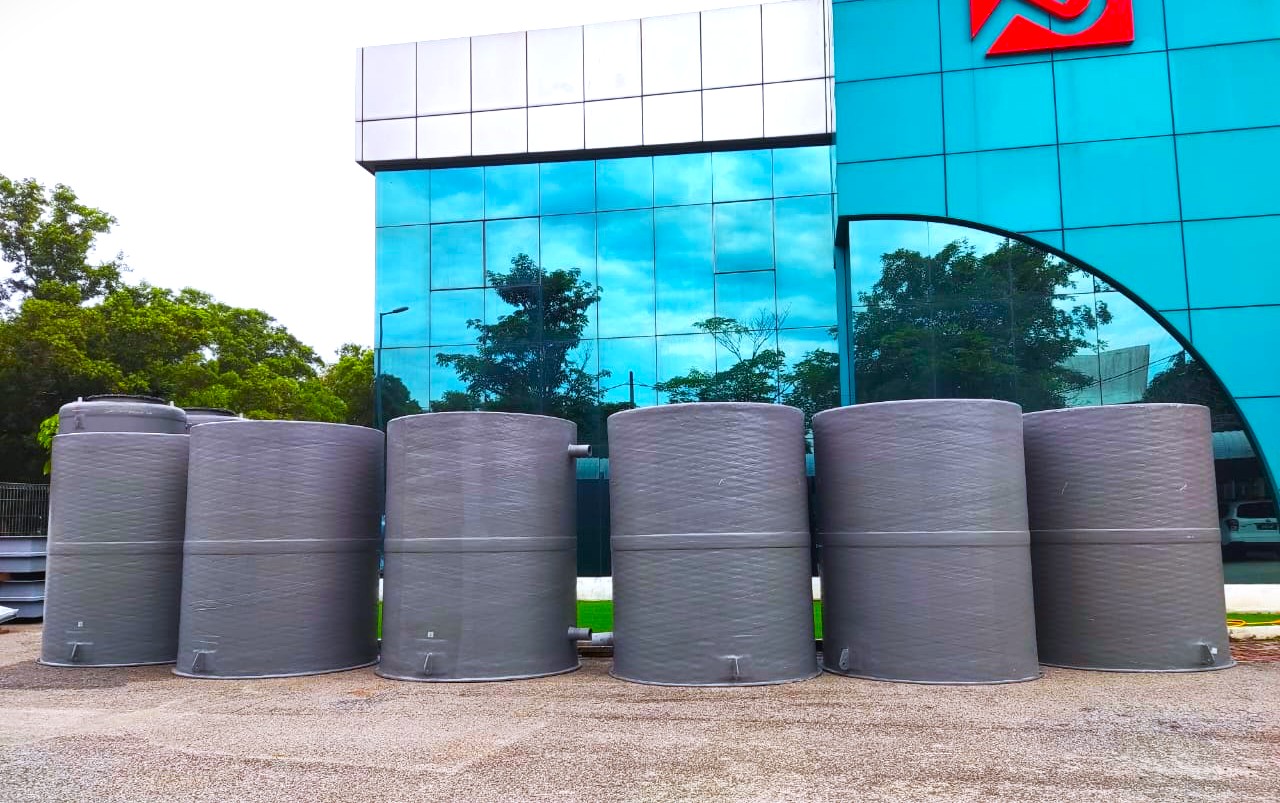
FRP Tank Supplier in Malaysia: How to Specify and Buy the Right Tank
Search for an FRP tank supplier in Malaysia and you will get two completely different kinds of company on the same results page. One group sells bolted sectional panel tanks for water storage. The other engineers custom vessels to hold acid, caustic and process effluent. They both call the product an FRP tank. They are not remotely the same purchase.
If you are storing water, the first group will serve you well and cheaply. If you are storing anything corrosive, buying from them is a mistake that surfaces about eighteen months later as a blistered laminate and a chemical on your floor.
This guide is for the second case. It covers how industrial FRP tanks are actually built, how to specify the resin system, which design codes apply, what Malaysian environmental regulations require of your installation, and how to tell a competent FRP tank supplier from one who is quoting you a number without doing any engineering.
Sectional panel tanks vs engineered process vessels
Get this distinction right before you request a single quotation.
| Sectional panel tank | Engineered FRP process vessel | |
|---|---|---|
| Construction | Bolted GRP panels, hot-pressed from SMC | Filament wound or hand laid as a monolithic shell |
| Design basis | Standard panel sizes, catalogue capacities | Custom design calculation per project |
| Resin | General-purpose polyester | Selected against your specific chemistry |
| Corrosion barrier | Not a design feature | Engineered layer, thickness specified |
| Typical use | Potable water, fire reserve, rainwater | Acid, caustic, solvent, effluent, process liquor |
| Bought on | Capacity and price | Chemical compatibility and design life |
A panel tank has hundreds of bolted joints and gasket lines. For water, that is fine. For hydrochloric acid, every joint is a leak waiting to happen and there is no continuous corrosion barrier to protect. Corrosive service needs a monolithic vessel with an engineered liner.
How an FRP tank is actually built
An FRP tank wall is not one material. It is a layered system in which each layer does a different job, and understanding the layers is what lets you read a quotation properly.
The corrosion barrier
The inner surface that contacts your chemical. It is deliberately resin-rich — in the region of 70–85% resin by volume — because it is the resin, not the glass, that resists chemical attack. It is built from a surfacing veil backed by chopped strand mat.
Barrier thickness is specified by service severity: broadly 2.0–2.5 mm for mild duty, 2.5–4.0 mm for moderate, and 4.0–6.0 mm for severe. This is the layer that fails first, and its thickness is one of the most revealing line items in any quotation. If a quote does not state corrosion barrier thickness, the supplier has not designed a corrosion barrier.
The veil
A thin surfacing layer at the very inside face. The choice is chemistry-specific:
- C-glass veil — the usual choice where acid resistance is the priority
- E-CR glass — better suited to caustic and alkaline service
- Synthetic or carbon veil — superior barrier performance; carbon veil additionally dissipates static, which matters for flammable media
The structural laminate
Behind the barrier, glass carries the load — hydrostatic head, wind, seismic, the weight of the contents, and any vacuum or pressure. This is where filament winding earns its place.
The exterior
A resin-rich outer coat, normally UV-stabilised. Under Malaysian sun, outdoor tanks without UV protection chalk and degrade at the surface. Specify it.
Filament winding, hand lay-up and dual laminate
Filament winding draws continuous glass roving through a resin bath and lays it onto a rotating mandrel under controlled tension and at a controlled wind angle. Because fibre placement is machine-controlled and repeatable, the laminate is denser, stronger and far more consistent than hand work. It is the standard method for cylindrical vessels.
At POLYDAMIC we operate two filament winding machines in-house and prefabricate cylindrical tanks up to 4 metres in diameter in the workshop. Beyond that, transport becomes the limiting factor — which is why we also build on site using vertical winders. It is worth asking any supplier about this early: a tank that cannot legally travel to your site is not a tank you can buy, and buyers routinely discover this only after specifying a diameter.
Tanks are configured with flat or domed tops, and flat, sloped or conical bottoms depending on whether you need bulk storage, complete drainage or solids handling.
Hand lay-up (contact moulding) is used for rectangular tanks, ducting, hoods, clarifiers and irregular geometry. Rectangular vessels carry bending loads that cylinders do not, so ours are reinforced with mild steel framing to control wall deflection.
Dual laminate construction puts a thermoplastic liner — typically 3–5 mm — inside an FRP structural shell. The thermoplastic provides chemical resistance that no resin can match; the FRP behind it provides the strength. The liner is not counted as structural. We fabricate dual laminates in PVC, CPVC, PP and PVDF, and the choice is driven entirely by your chemistry and temperature.
Dual laminate costs more. For aggressive or high-purity service it is often the only construction that will give you a sensible design life, and specifying plain FRP where dual laminate is needed is one of the more expensive mistakes in this market.
Resin selection: where most tanks are won or lost
The glass reinforcement is broadly comparable between suppliers. The resin system determines service life. It must be matched to three things together — the chemical species, its concentration, and its operating temperature. Change any one and the answer can change completely.
| Resin system | Broad capability | Typical continuous service temperature | Common applications |
|---|---|---|---|
| Orthophthalic polyester | Low-duty, non-corrosive | Lowest of the group | General water, low-demand storage |
| Isophthalic polyester | Dilute acids, salt solutions, most aliphatic hydrocarbons | Roughly 82–99°C | Water storage, mild effluent, general process |
| Bisphenol-A vinyl ester | Mid-concentration acids, dilute caustics, hot water, thermal cycling | Roughly 104–121°C | Scrubbers, acid storage, chlor-alkali, wastewater |
| Epoxy novolac vinyl ester | Oxidising acids, high concentrations, continuous solvent exposure | Higher again, into ~200°C in certain gas service | Bleaching towers, HCl absorbers, aggressive process |
| Dual laminate (thermoplastic lined) | Extreme, mixed or high-purity chemistry | Depends on liner polymer | Semiconductor chemistries, specialist process fluids |
Some rules of thumb worth carrying into your next vendor conversation:
- Isophthalic polyester handles sulphuric below roughly 25% and hydrochloric below roughly 10% reasonably. It struggles above pH 10, with oxidising acids, and in hot water above about 65°C, where the ester linkages hydrolyse and the laminate blisters.
- Isophthalic polyester is generally rated Not Recommended for sodium hypochlorite. Hypochlorite is among the most aggressive common chemicals for FRP, and it is widely used in Malaysian water treatment and disinfection. Specifying isophthalic for a hypochlorite day tank is a well-documented way to buy a failure.
- Ambient compatibility does not mean hot compatibility. A resin fine with a chemical at 30°C may be unsuitable at 60°C, because diffusion and hydrolysis both accelerate with temperature.
- A common and sound commercial compromise is a vinyl ester corrosion barrier and first structural ply, with isophthalic behind it for bulk structure. You pay for premium resin where it does the work.
All figures above are industry-typical and indicative. Any responsible supplier will confirm the final selection against the resin manufacturer’s chemical resistance chart for that grade at your concentration and temperature — not from a general table like this one.
Design codes: what to specify, and one thing most suppliers get wrong
Almost every FRP fabricator in Malaysia advertises BS 4994. It is worth knowing that BS 4994:1987 was withdrawn and is superseded by BS EN 13121-3, currently the 2016 edition, together with BS EN 13923 for filament-wound vessels. The 2016 revision was substantially rewritten to align with the Eurocode structural framework.
That does not make BS 4994 useless. It remains widely specified across Asia and the Middle East, it is the governing reference for the very large installed base of vessels built to it, and many engineers regard it as more field-proven. But a supplier who does not know it has been superseded is telling you something about their engineering currency.
The codes in play:
- BS EN 13121-3:2016 — design, fabrication, inspection and testing of above-ground GRP tanks and vessels, with or without thermoplastic lining, unpressurised or pressurised to 10 bar, for service between −40°C and +120°C. Factory-made or site-built.
- BS EN 13121-2 — chemical resistance of the composite materials.
- BS 4994:1987 — withdrawn but still commonly specified; relevant for existing assets.
- ASME RTP-1 — the US code for corrosion-resistant reinforced thermoset plastic equipment, generally to 15 psig.
- ASTM D3299 — filament-wound chemical-resistant tanks.
- ASTM D4097 — contact-moulded (hand laid) tanks.
Whichever code applies, ask for the design calculation, not just a wall thickness figure. A thickness without a calculation behind it is a guess dressed as a specification.
What Malaysian regulations require of your tank installation
This is the part buyers most often discover late — usually during a DOE inspection.
Environmental Quality Act 1974 and the Environmental Quality (Scheduled Wastes) Regulations 2005, enforced by the Department of Environment, govern how you store anything classified as scheduled waste. The First Schedule lists 77 waste categories across SW1 to SW5. Waste must be held in durable containers that prevent spillage or leakage, labelled in accordance with the Third Schedule, and volumes reported monthly to DOE through eSWIS.
Under the DOSH Guidelines on Storage of Hazardous Chemicals, outdoor storage requires bunding enclosing at least 110% of the largest container’s capacity, over an impervious surface graded so that any spill drains to a contained point.
Here is the failure mode almost nobody plans for. Concrete bunds do not resist concentrated acid. Acid attacks the cement matrix, the bund cracks, and the containment you are relying on for compliance becomes a direct route into soil and groundwater — while still looking perfectly intact from above. The same applies to wastewater sumps.
The fix is to laminate the concrete with a chemical-resistant FRP layer. POLYDAMIC applies fiberglass lamination directly to concrete bunds and wastewater sumps, and to metal surfaces on tankers and existing process tanks, giving you a corrosion barrier over an asset you have already built. It is frequently faster and cheaper than replacement, and it turns a bund that would fail an inspection into one that passes.
If you are unsure what your installation needs, we also provide consultation for DOE applications and LEV assessment — so the vessel, the containment and the paperwork are handled by one party rather than three.
What to send your supplier before asking for a price
Quotations vary wildly when the input data is thin, because suppliers price their assumptions. Give every bidder the same information and the quotes become comparable:
- Chemical — species, concentration, and any trace or minor components. Mixtures can be more aggressive than any single constituent.
- Temperature — normal operating, maximum, and whether it cycles.
- Capacity and geometry — working volume, preferred diameter and height, or the footprint you have available.
- Pressure/vacuum — atmospheric, pressurised, or subject to vacuum during pump-out. Vacuum is a common omission and a common cause of collapse.
- Installation — indoor or outdoor, ambient UV and rain exposure, seismic or wind requirements.
- Nozzles and fittings — full schedule with sizes, orientations and elevations.
- Accessories — manways, ladders, platforms, handrails, level instruments, vents, agitator mountings.
- Code — which design standard the vessel must comply with.
- Site access — crane availability and the largest section that can physically reach your location.
Every penetration and attachment should be laminated in during fabrication. Cutting a new nozzle into a finished vessel means breaching the corrosion barrier, and a field repair is never as sound as an integral one.
How to evaluate an FRP tank supplier in Malaysia
- Do they own their manufacturing? Ask whether they wind in-house or subcontract. Subcontracting puts a layer between you and laminate quality, and makes warranty claims slower.
- Do they ask questions before quoting? A supplier who asks about concentration and temperature is doing engineering. One who returns a price immediately is selling a commodity.
- Will they provide the design calculation? Not a thickness — the calculation, against a named code.
- Is corrosion barrier thickness stated? If it is absent from the quotation, it is absent from the design.
- What testing is included? Spark testing for pinholes, Barcol hardness for cure verification, thickness measurement. Every tank POLYDAMIC builds is spark tested — a pinhole is a void invisible to the eye that becomes a leak path in service, and it should be found in the workshop, not after commissioning.
- Can they build on site? Determines your maximum practical tank size.
- Do they offer dual laminate? If not, they will steer you toward plain FRP even where your chemistry needs a liner.
- Quality certification. ISO 9001 indicates documented, repeatable process control rather than craft-by-craft variation.
- Who installs and who maintains? Lifting, setting, connecting, commissioning — and who you call in year seven.
- Track record in your industry. Ask for reference installations you can actually visit.
Warning signs
- A price quoted before anyone has asked what you’re storing
- “Fiberglass handles everything” — it does not; resin selection exists for a reason
- No corrosion barrier specification anywhere in the document
- Vagueness about which code the design follows
- No non-destructive testing offered as standard
- A water tank supplier quoting for chemical service
What drives the price
FRP tank pricing is not primarily about volume. The main cost drivers are resin system (vinyl ester runs materially higher than isophthalic; novolac and dual laminate higher again), corrosion barrier thickness, design code and documentation, nozzle and accessory count, site build versus workshop build, and installation scope.
Which is why comparing quotations on headline price alone is misleading. A quote that is thirty percent cheaper is usually cheaper because it specifies less — thinner barrier, cheaper resin, no calculation, no testing. You find out which, some years later.
Set against a coated steel alternative, FRP typically costs more up front and less over the asset’s life, because it avoids the recurring cycle of inspection, recoating, downtime and eventual replacement. Well-designed and properly inspected FRP vessels commonly give 30 to 40 years of service.
Keeping a tank in service
FRP is low-maintenance, not no-maintenance:
- Annual external inspection — crazing, star cracks at nozzles, discolouration, exposed glass fibre
- Internal inspection at planned shutdowns — the corrosion barrier is where degradation begins, and microcracking is hard to see until it is well advanced or stained by the process fluid
- Watch the nozzles — piping loads transferred into the shell cause more FRP failures than chemistry does. Support your pipework independently.
- Respect the vents — a blocked vent plus a transfer pump is how tanks implode
- Repairs are practical — damaged laminate can be ground back and re-laminated in place, restoring the barrier without removing the vessel
Why work with POLYDAMIC
POLYDAMIC Group Berhad has been engineering FRP and corrosion-resistant equipment since 1996, and is a listed company operating from Penang, Perak and Selangor. We are ISO 9001:2015 certified and supply customers across Malaysia, Singapore, India, Hong Kong, the Philippines and the Middle East.
What we bring to a tank project:
- Filament winding in-house — two machines, up to 4 m diameter in the workshop, larger vessels wound on site
- Hand lay-up for rectangular and complex geometry, steel-reinforced
- Dual laminate in PVC, CPVC, PP and PVDF where chemistry demands it
- Spark testing on every tank
- FRP lining of concrete bunds and sumps, and of existing steel vessels
- A full corrosion-resistant product range — tanks, ducting, clarifiers, scrubbers, FRP centrifugal fans, moulded FRP grating, fume cupboards
- DOE and LEV consultancy in-house, so compliance is engineered in rather than retrofitted
- Engineers and site installation technicians on the same team — one point of accountability from design through commissioning