

Top Applications of Fiberglass Manufacturing in Malaysia’s Environmental Engineering Industry
Introduction
Malaysia’s industrial sector has grown rapidly over the past two decades, bringing with it an increasing demand for durable, chemical-resistant, and cost-effective materials. At the forefront of this demand is Fiberglass Reinforced Plastic (FRP) — a versatile composite material that has become indispensable in environmental engineering across the country.
From wastewater treatment plants in Johor to chemical processing facilities in Penang, fiberglass manufacturing plays a critical role in helping Malaysian industries meet operational, safety, and regulatory requirements. In this article, we explore the top applications of fiberglass manufacturing in Malaysia’s environmental engineering industry and why it continues to outperform traditional materials like steel and concrete.
What Is Fiberglass and Why Does It Matter in Environmental Engineering?
Fiberglass Reinforced Plastic (FRP) is a composite material made from a polymer matrix reinforced with glass fibres. The result is a material that is:
- Lightweight yet extremely strong
- Highly resistant to corrosion and chemical attack
- Low maintenance over its lifespan
- Customisable in shape, size, and thickness
- Compliant with environmental and safety standards
These properties make fiberglass the material of choice for environmental engineering applications where exposure to harsh chemicals, moisture, and outdoor conditions is a daily reality.
1. Air Pollution Control Systems
One of the most critical applications of fiberglass in Malaysia’s environmental engineering sector is in air pollution control systems, particularly wet scrubber systems and exhaust ventilation ducting.
Scrubbers are used to remove harmful gases and particulates from industrial emissions before they are released into the atmosphere. These systems are constantly exposed to corrosive chemicals such as hydrochloric acid (HCl), sulphuric acid (H₂SO₄), and ammonia — environments where steel would corrode within months.
FRP scrubber housings, ducting, and stack chimneys offer:
- Excellent resistance to acidic and alkaline gases
- Long service life with minimal maintenance
- Compliance with Malaysia’s Environmental Quality Act (EQA) 1974 and DOE regulations
- Lightweight construction that simplifies installation at height
Companies in industries such as semiconductor manufacturing, rubber glove production, metal finishing, and chemical processing rely heavily on FRP-based air pollution control systems to remain compliant with the Department of Environment (DOE) Malaysia.
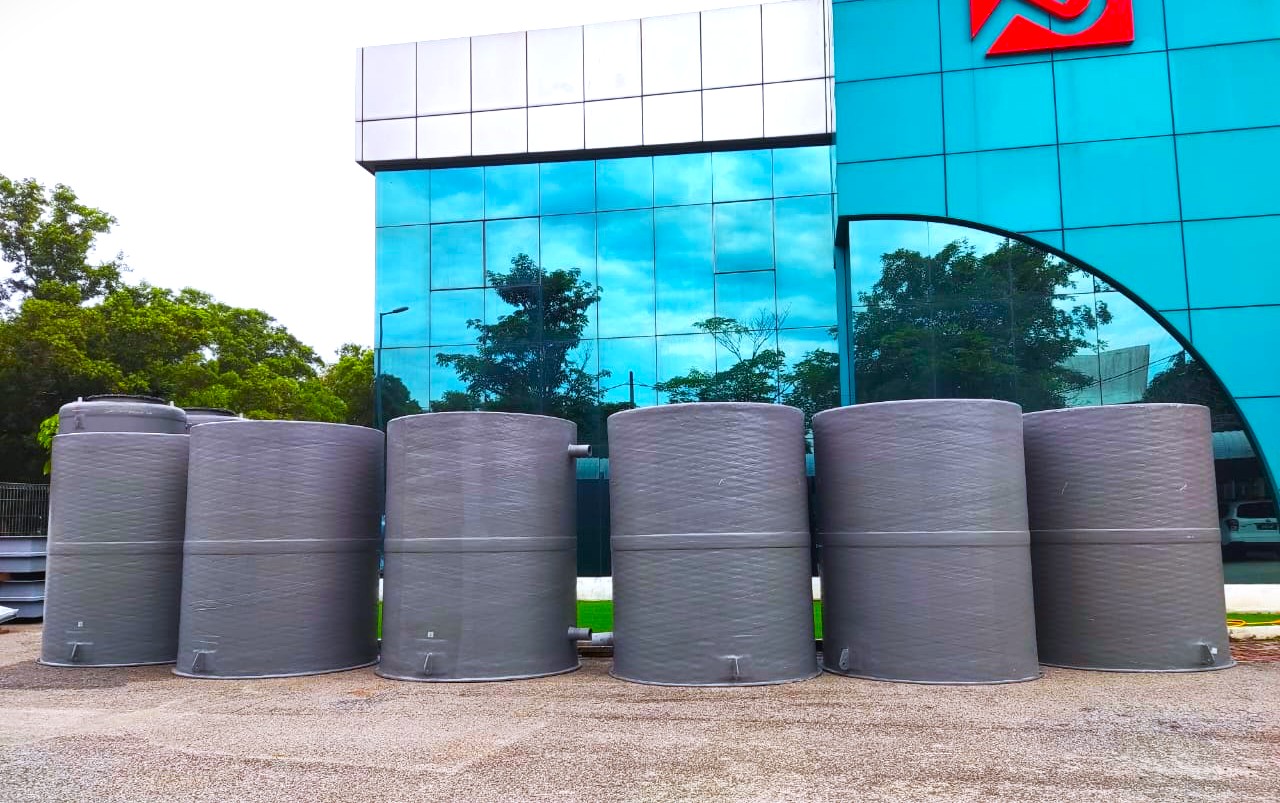
2. FRP Storage Tanks for Chemical and Wastewater Applications
FRP tanks are among the most widely used fiberglass products in Malaysia’s environmental engineering industry. They are used to store a wide variety of substances including:
- Industrial wastewater
- Acid and alkali chemicals
- Treated water
- Effluent before discharge
Unlike stainless steel or concrete tanks, FRP storage tanks do not rust, crack, or react with the stored chemicals. They can be custom-fabricated to virtually any size and volume, making them suitable for both small laboratory setups and large industrial plants.
In Malaysia, FRP tanks are commonly deployed in:
- Effluent Treatment Plants (ETP) in manufacturing zones
- Palm oil mills for storing process chemicals
- Electronics and semiconductor factories handling ultra-pure or corrosive liquids
- Water treatment facilities across municipal and private sectors
The ability to manufacture FRP tanks locally in Malaysia also reduces lead times and costs compared to importing stainless steel alternatives.
3. Laboratory Fume Hoods and Exhaust Systems
Laboratories in Malaysia — whether in universities, hospitals, research institutions, or industrial quality control departments — require fume hoods that can safely contain and exhaust hazardous chemical vapours.
Fiberglass fume hoods offer significant advantages over traditional steel or PP (polypropylene) alternatives:
- Superior chemical resistance to a broad spectrum of acids, solvents, and alkalis
- Non-sparking construction suitable for use with flammable chemicals
- Smooth interior surfaces that are easy to clean and decontaminate
- Durability in humid, tropical conditions like Malaysia’s climate
FRP is also used in the exhaust ducting connected to fume hoods. The ductwork carries corrosive chemical fumes from the lab to the rooftop discharge point, and any material that cannot withstand constant chemical exposure would deteriorate rapidly. Fiberglass ducting solves this problem completely.
With Malaysia’s growing biomedical, pharmaceutical, and semiconductor research sectors, the demand for high-quality FRP laboratory exhaust systems continues to rise.
4. FRP Grating for Industrial Walkways and Platforms
Environmental engineering facilities such as wastewater treatment plants, chemical storage areas, and scrubber platforms require safe, slip-resistant, and corrosion-proof flooring solutions.
FRP moulded grating is the industry standard for these environments in Malaysia. It offers:
- Anti-slip gritted surfaces for worker safety in wet or chemical-exposed areas
- Corrosion resistance that eliminates the repainting and re-galvanising cycles associated with steel grating
- Lightweight panels (typically 4ft x 8ft) for fast and easy installation
- High load-bearing capacity relative to its weight
FRP grating is widely used on:
- Walkways above chemical tanks and sumps
- Platforms around scrubber systems and chimneys
- Drainage covers in factories and treatment plants
- Offshore and coastal installations where saltwater corrosion is a concern
For facilities that must comply with DOSH (Department of Occupational Safety and Health) requirements, FRP grating provides a practical and long-lasting solution that reduces the risk of slip-and-fall accidents.
5. Fiberglass Centrifugal Fans for Corrosive Gas Extraction
Standard metal fans deteriorate quickly when used to extract corrosive gases in chemical plants, laboratories, or surface treatment facilities. Fiberglass centrifugal fans are engineered specifically to handle these demanding conditions.
In Malaysia’s environmental engineering industry, FRP centrifugal fans are used in:
- Acid fume extraction in electroplating and metal finishing workshops
- Chemical laboratory ventilation systems
- Scrubber system air movers where the fan handles pre-cleaned corrosive air
- Solvent vapour exhaust in paint shops and coating facilities
The fan housing, impeller, and inlet cone are all fabricated from fiberglass, ensuring that even prolonged contact with acidic or alkaline fumes does not compromise performance or structural integrity.
6. Ducting and Hoods for Local Exhaust Ventilation (LEV) Systems
Under OSHA 1994 and guidelines from DOSH Malaysia, many industrial facilities are required to implement Local Exhaust Ventilation (LEV) systems to protect workers from exposure to airborne chemical hazards.
Fiberglass is the preferred material for LEV system components — including hoods, ducts, and plenums — when the process involves:
- Acid mist or chemical vapours
- High-humidity or high-temperature exhaust streams
- Long duct runs exposed to outdoor weather
FRP LEV components are custom-fabricated based on engineering calculations covering airflow velocity, static pressure, and hood capture efficiency. Their corrosion resistance ensures the system continues to perform as designed over many years without structural degradation.
7. Effluent Treatment Plant (ETP) Components
Malaysia’s Environmental Quality Act mandates that industrial effluent be treated to acceptable standards before discharge. Effluent Treatment Plants (ETPs) are therefore a legal requirement for many manufacturers.
Fiberglass is extensively used throughout ETPs for components such as:
- Equalisation and reaction tanks
- Settling and clarifier tanks
- Chemical dosing tanks
- Sludge holding tanks
- Pipes, fittings, and manholes
The advantage of FRP in ETP construction is its ability to handle pH extremes — both highly acidic and highly alkaline effluent — without degrading. This is something neither concrete nor mild steel can offer without expensive lining systems.
Why Malaysian Industries Choose Local Fiberglass Manufacturers
Working with a local fiberglass manufacturer in Malaysia offers several practical advantages:
- Faster turnaround — custom tanks, ducting, and equipment can be fabricated and delivered without long import lead times
- Site-specific fabrication — products are built to the exact dimensions of your facility
- Engineering support — local manufacturers understand Malaysian DOE and DOSH compliance requirements
- After-sales service — maintenance and repairs can be handled quickly by the same team
- Cost savings — avoiding import duties and freight costs on heavy industrial equipment
Conclusion
Fiberglass manufacturing sits at the heart of Malaysia’s environmental engineering industry. From air pollution control and chemical storage to laboratory safety and worker protection, FRP products provide the durability, chemical resistance, and compliance-readiness that modern Malaysian industry demands.
As environmental regulations continue to tighten and industries expand, the role of fiberglass in engineering sustainable and safe industrial environments will only grow stronger.